
FAQs
Have a question? Before getting in touch, you may find your answer in our FAQs below.
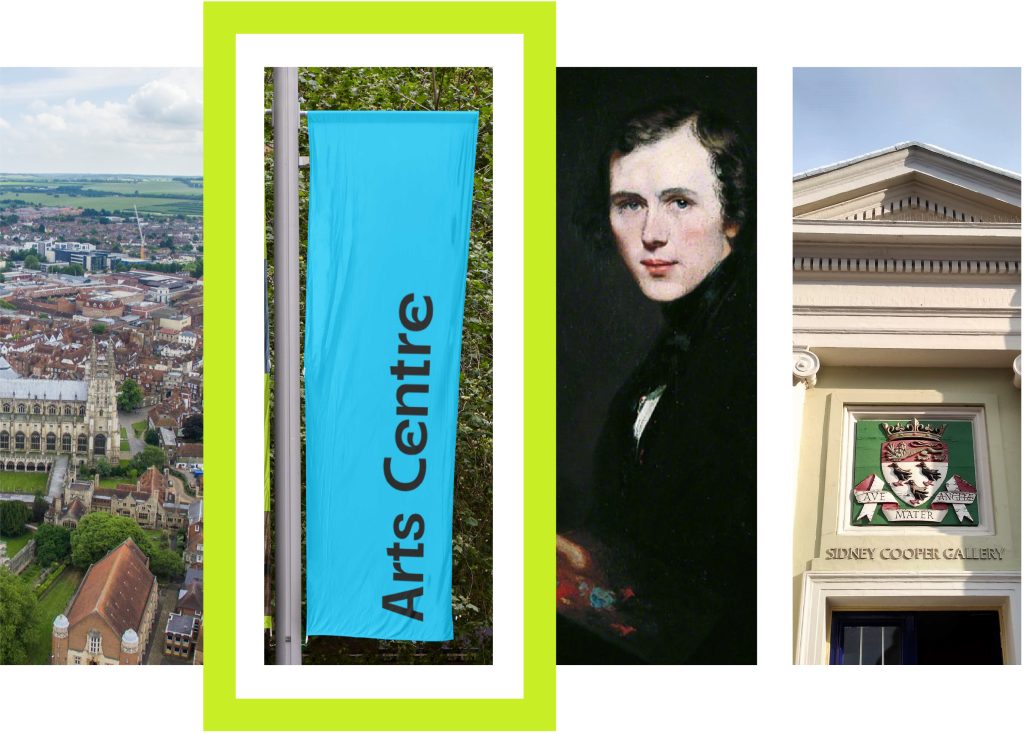
Thomas Sidney Cooper: the artist
One of the finest landscape painters of his day, Cooper is mainly associated with pictures of cattle or sheep, a fact that earned him the epithet “Cow Cooper”. Self-taught he rose from poverty to become highly successful by painting for the emerging middle classes and the new industrialists of the era. He had constant commissions, and patronage from Queen Victoria, and travelled around the country, sometimes with his son, painting in Wales, Scotland and the Lake District as well as his home county of Kent.
Cooper was elected an Associate of the Royal Academy (ARA) in 1845 and Royal Academician (RA) on 22 June 1867.
Seen through the lens of today the work may look whimsical or nostalgic but at the time it was groundbreaking. His sensibility for nature, landscape, and the animals in it, has left us a large and recognisable body of work that spans 80 years, closest in style to the Dutch Old Masters. His finest monumental works such as ‘Monarch of the Meadows’ and’ Separated, but not Divorced’ stand comparison with Landseer’s ‘Monarch of the Glen’.
Cooper still holds the record for the longest continuing exhibiting at the Royal Academy, 57 years. His ‘Intercepted Raid, Ettrick Shepherd’, exhibited at the Royal Academy in 1842, an oil on canvas, sold at Sotheby’s for £37,500 making it, at that time, the most valuable work to be sold at auction.
In his last years he was a household name, as famous as Constable and Landseer and his deteriorating health towards the end was a national concern, reported in newspapers, one of which referred to him as the ‘grand old man of art’. So prolific a painter was he that the studio sale conducted by Christies in 1902 after his death lasted a full three days. Cooper was one of the earliest artists to use photography as an aid to creating compositions for his paintings. He used a photomontage technique, overlaying photographs and sketches of landscapes and animals until he achieved a suitable composition.
The largest public collection of Cooper paintings is owned by Canterbury City Council and housed at the Beaney House of Art & Knowledge in Canterbury. Examples are also held by the Tate Gallery, National Gallery and the Victoria and Albert Museum and in many provincial galleries in England.
The definitive account of his life and catalogue of his work ‘Thomas Sidney Cooper – His Life and Work’, by Kenneth Westwood was published in two volumes in 2011 by David Leathers, Ilminster. Used copies of the books can be purchased here.
New hardback published in 2026 ‘Separated, but not Divorced – The artistic life and times of Thomas Sidney Cooper’ by Darren Henley, CEO of the Arts Council England, Canterbury resident. Hardback, 800pp, 36 colour illustrations. Available from The Beaney Museum and by contacting info@sidneycooperarts.org (‘Separated, but not Divorced’ is the title of the magnificent picture of Charlie the Bull displayed in The Beaney Museum, Canterbury. Darren argues that this is a good allegory for the life of Sidney himself – self-taught, he became a highly successful painter but was never really accepted by the London art ‘establishment’.)
A paperback by Brian Stewart (1983) Thomas Sidney Cooper of Canterbury celebrates Cooper’s life and legacy to Canterbury. The publisher, Meresborough, no longer exists however second hand books can be purchased online. New paperback editions of Thomas Sidney Cooper’s autobiography ‘My Life’ (originally published in 1890) can be found online.
The Sidney Cooper building: St Peter’s Street, Canterbury
Canterbury City Council owns the Sidney Cooper building on St Peter’s Street, Canterbury. The building was bequeathed to the city by Cooper in 1868 and used continuously as an art school for over 100 years.
After the Canterbury School of Art moved out of the premises in 1973 the building was renovated and opened as the Sidney Cooper Centre, used by community groups and art societies as well as the University for the Creative Arts as a working studio and exhibition space.
In 2004, after further renovations and another name change to the Sidney Cooper Gallery, Canterbury Christ Church University used the building to house its fine art faculty and exhibit the work of students and local and national artists. CCCU returned the Gallery to the care of the Canterbury City Council (CCC) in 2020 since when it has been empty. The Gallery is now listed on CCC’s official ‘Register of Community Assets’.
The Sidney Cooper School of Art started by Cooper in 1868 was highly successful.
The school was affiliated with the Science and Art Department in South Kensington led by Henry Cole, the first director of the Victoria and Albert Museum. Cooper’s fellow Academician friends Frederick Leighton and Edwin Landseer among others donated casts, statues and drawings for students to study and some donated their time to act as examiners, including Lawrence Alma-Tadema, William Morris and Edward Poynter.
Amongst Cooper’s more well-known students was Mary Tourtel, creator and illustrator of the Rupert Bear books for children. Cooper himself came regularly to teach, often staying late in the evenings to help those boys and girls who could not come during the day. In 1870, at the age of 67, he received the freedom of the city of Canterbury in recognition of the school and gallery he had established.
By the 1930s the school was offering courses on a wide range of arts and crafts including drawing and painting, architecture and building trades, dress design and millinery, cabinet work, woodcarving, upholstery, stone carving and letter cutting. It remained open during the Second World War offering free courses to members of the forces.
The school became a College of Art in 1947 under the auspices of the Kent Education Committee. Student numbers increased rapidly in the post-war period, with Foundation Studies and the School of Fine Art emerging in the early 1960s. The School of Architecture was formally inaugurated in 1952. Ian Dury of Blockheads fame taught at the College from 1970-1973, when it was known as the Canterbury College of Art, as noted by a recently erected Blue Plaque on the front.
The college rapidly outgrew the site on St Peter’s Street and in 1973, Canterbury College of Art moved to a new building on the New Dover Road, Canterbury where it eventually merged with Maidstone and Medway College to form the Kent Institute of Art and Design in 1987. The Kent Institute of Art and Design and the Surrey Institute of Art and Design merged in 2005 to become the University College for Creative Arts. After gaining accreditation in 2008, it became the University for the Creative Arts.
After some renovations in 1975 the newly opened Sidney Cooper Centre was used by community groups and art societies as well as the University for the Creative Arts as a working studio and exhibition space. In 2004, after further renovations and another name change to the Sidney Cooper Gallery, Canterbury Christ Church University used the building to house its fine art faculty and exhibit the work of students and local and national artists. CCCU returned the Gallery to the care of the Canterbury City Council (CCC) in 2020 since when it has been empty.
The building was bequeathed to the city by Cooper in 1882 with a covenant that ensured that in the future it would be used for arts endeavours and arts education.
The Council has stated that it will put out an Expression of Interest on the building in 2026, inviting groups to tender proposals for the future of the building.
The Sidney Cooper Arts Trust has been formed to tender for the building with a view to reopening it as an arts centre for the community of Canterbury, in celebration of and continuing the legacy of Thomas Sidney Cooper.
The Trust aims that any future development of the centre will be driven by and respond to the needs of the community, and is likely to be a multi-use space for exhibitions, youth art programmes, adult education workshops, and spaces where local artists, art societies and the local universities and colleges can display their work in the centre of the city.
The Trust is ambitious for the role of the building, what will happen inside it, and its work with education partners and the community. Any development of the building should be exceptional and pioneering, raising the bar for arts centres and for what is expected of their role in the community, as a catalyst for artistic endeavour and a contributor to wellbeing across the whole community.
It will also act as a high-quality tourist attraction, complementing the existing attractions of the Cathedral, Marlowe and others as well as the heritage urban environment of the city centre. It has easy access for visitors (walking, bicycles, buses and stations in walking distance),and will support the economic regeneration of the Westgate Towers area (with links to the Curzon and Westgate Hall) and the city centre.
The new development also directly supports the aims of the Levelling Up funded work, and the current Council strategies in preparation on Culture and on Place Making, both of which aim to celebrate past history, attract new visitors and private investment, making the city a more beautiful and sustainable place to live, work, learn and visit, focused on the city’s rich heritage and culture. A newly opened Gallery will hope to echo the success of Turner Contemporary in Margate and other regeneration arts-focussed projects across Kent and the South East, including Creative Folkestone, the Hastings Contemporary, The De La Warr at Bexhill and Towner in Eastbourne which have balanced community need with national standard art centres to bring revenue to old town centres.
The listed designation relates to the combined building at 22 and 23 St Peter’s Street, Canterbury (Grade II; National Heritage List for England entry 1242345). In other words, the listing covers the whole building at Nos. 22–23, not just the gallery space.
What the official list entry describes:
No. 22: a much-restored 16th-century timber-framed house; the right-hand part is two storeys with a gable, and the ground floor has a Georgian bow window with reeded pilasters. [1]
No. 23: the left-hand part has an early-19th-century neo-classical pediment and plain Ionic columns (with a motto referenced in the list entry). [1]
What “listed” generally covers:
Historic England explains that, unless a list entry states otherwise, legal protection includes the structure itself and anything fixed to it (inside or outside), and can also include objects/structures within the building’s curtilage that formed part of the land before 1 July 1948. [1][2]
References:
[1] Historic England. “22 AND 23, ST PETER’S STREET” (List Entry 1242345), National Heritage List for England. First listed 3 May 1967. Accessed 14 January 2026.
Thomas Sidney Cooper: the man
Thomas Sidney Cooper was born in St Peter’s Street in Canterbury and baptised as St Peter’s Church. As a small child he began to show strong artistic talent, but his family had little money (his father had deserted the family when the boy was five) and could not pay for any tuition, or even for paper and pencils. It was the then Archbishop of Canterbury who saw him sketching the cathedral on his school slate and, recognising his talent, gave him his first paper and pencils.
To help support the family Cooper at twelve was working as a coach painter, then later as a scenery painter with a travelling theatre company. He still had a driving desire to become an artist, and all his spare moments were spent drawing and painting from nature. At the age of twenty he went to London, drew for a while in the British Museum, and after much perseverance was admitted as a student of the Royal Academy.
Unable to afford to continue living in London he was forced to return to Canterbury, where he earnt a living as a drawing master and by the sale of sketches and drawings. In 1827 he and friend went to Brussels and through some luck and perseverance, Cooper started to make a living through painting portraits and becoming a drawing master. Here he met and married Charlotte Pearson.
The Belgian Revolution of 1830 saw Cooper and Charlotte returning hastily to Canterbury with their first child. Cooper tried his luck in London again, selling sketches and teaching and showed his first picture at the Royal Academy in 1833, beginning a long and prolific career as an exhibitor at the Royal Academy and British Institution among others.
He was friends with Landseer, Frederick Leighton, Maclise, William Morris and Charles Dickens. He had a long acquaintanceship with JMW Turner whom he describes in his autobiography as taking a ‘great interest in me and my success’. Cooper also was favoured by Queen Victoria who invited him to Osborne House on the Isle of Wight to paint.
In London he moved in elevated circles, counting many artists, politicians and writers, including Charles Dickens, as his friends. He had a long acquaintanceship with JMW Turner whom he describes in his autobiography as taking a ‘great interest in me and my success’. Sidney Cooper died in February 1902 at 98 years. His funeral was held in Canterbury Cathedral; people lined the streets and flags were flown at half mast as his coffin was borne from his home at Harbledown. He is buried in St Martin’s churchyard, Canterbury, alongside his second wife and son Nevill.
Cooper had a long association with his birthplace, Canterbury. At the height of his fame in London he moved back to the city, building a house in Harbledown, named Vernon Holme in honour of his patron Robert Vernon, and lived in it until his death in 1902.The house is now part of Kent College Junior School and the Blue Plaque to Cooper can be seen on the front.
From the first year that he settled in Harbledown, he started breeding his own animals, so that he always had models at hand. He was of the opinion that ‘all Landscape painters should live in the country’.
He loved the theatre and in 1856 bought a block of buildings on Guildhall Street and, drawing on his past experiences as a scenery painter, designed a new theatre for Canterbury. His great friend Charles Dickens, who gave a reading there as part of his world tour of readings, praised the design saying ‘Why Cooper, I have not had to make the slightest effort to send my voice even to the back seats of the gallery’. His greatest contribution to the city was the Sidney Cooper School of Art founded in 1868 and handed over to the city in 1882 and which remained an art school for over 100 years before moving off site and becoming eventually incorporated into the University for the Creative Arts.
Arts in Canterbury
Lorem ipsum dolor sit amet, consectetur adipiscing elit, sed do eiusmod tempor incididunt ut labore et dolore magna aliqua. Ut enim ad minim veniam, quis nostrud exercitation ullamco laboris nisi ut aliquip ex ea commodo consequat.
Lorem ipsum dolor sit amet, consectetur adipiscing elit, sed do eiusmod tempor incididunt ut labore et dolore magna aliqua. Ut enim ad minim veniam, quis nostrud exercitation ullamco laboris nisi ut aliquip ex ea commodo consequat.
Get in touch
Contact us to find out more or tell us what you’d like to see in the new Arts Centre.